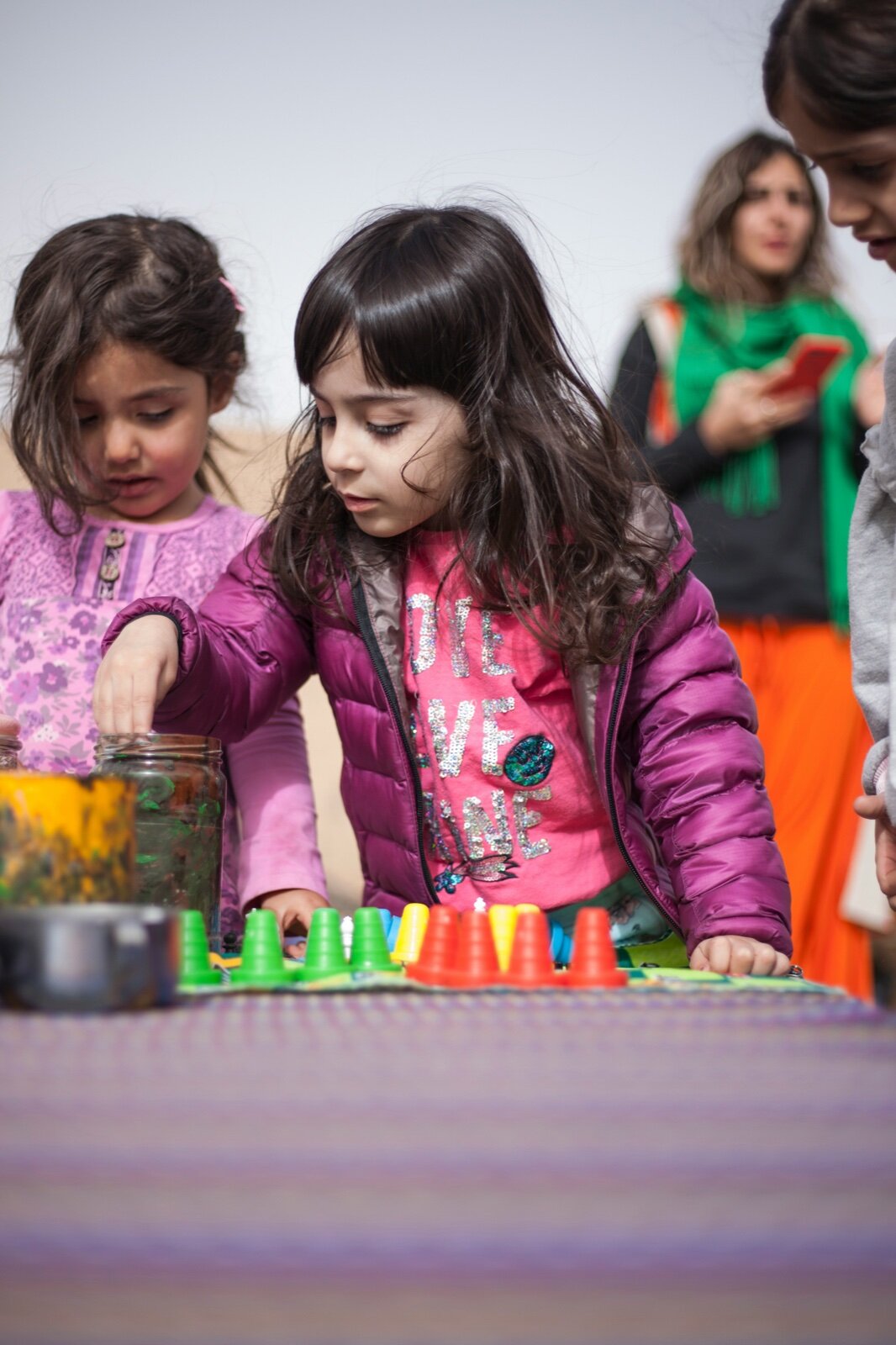
STEM at Ages 3–5
“STEM education” sounds like it belongs in a high school lab. But if your child has ever stacked blocks to see how tall they’ll go, poured water between cups at bath time, or asked “why?” for the fourteenth time today — they’re already doing it.
At this age, STEM is really just four kinds of everyday thinking.
Math: Patterns, Counting, and Sorting
Counting blueberries on a plate. Sorting buttons by color. Noticing a red-blue-red-blue pattern on a shirt and guessing what comes next. These are the building blocks of number sense — and they happen naturally at snack time, in the toy bin, everywhere.
Puzzles and shape games do the same thing for spatial reasoning. When your child says “the big triangle goes here,” that’s geometry at work.
Science: “What Happens If…?”
Three-year-olds are natural scientists. Dropping a rock and a leaf into a puddle to see which sinks. Mixing paint colors. Wondering where yesterday’s puddle went.
What’s happening underneath is hypothesis-testing — making a guess, trying it, and learning from what happens. Water play, cooking together, nature walks with a magnifying glass — it all counts.
Engineering: Build, Break, Try Again
Block towers are the classic. Not because stacking is the skill — the learning starts when the tower falls. Why? What if the bigger blocks go on the bottom?
This try-adjust-try-again cycle builds persistence and flexibility. A child who’s practiced it isn’t thrown by something hard — they know “it didn’t work” is information, not a stopping point.
Technology: Tools, Not Screens
The most misunderstood part. At this age, technology isn’t about devices — it’s about tools. A ramp, a magnifying glass, a pair of tongs. When your child tilts a ramp steeper to make the car go faster, they’re learning physics they can touch.
Simple sequencing fits here too: following recipe steps, knowing socks go on before shoes. These are early building blocks of procedural thinking.
Connecting It to Kindergarten
These four areas map directly to what kindergarten teachers look for:
- Number sense and patterns — counting, sorting, sequencing
- Observation and prediction — noticing details, making guesses
- Problem-solving — trying, adjusting, sticking with it
- Following steps and using tools — procedural thinking, cause and effect
STEM activities aren’t extras on top of kindergarten prep. They’re the same thing, just viewed through a different lens.
Simple Ways to Encourage It at Home
You don’t need a kit or a curriculum. Just a few questions during everyday play:
- “What do you think will happen if we add more water?”
- “Can you find all the ones that are the same shape?”
- “That fell down — what could we try differently?”
- “How many do you have? Let’s count together.”
The shift from play to intentional learning is often just one question away.
Want to see what this looks like in a small-group setting? Schedule a visit — we’d love to show you.